
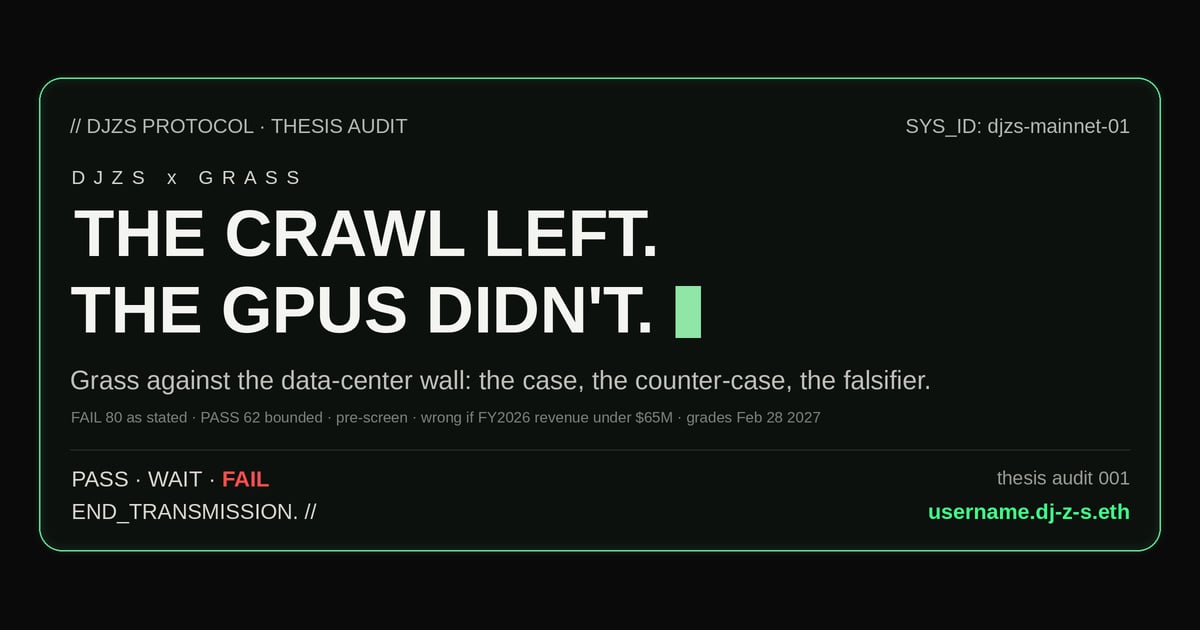
The thesis under audit is eight words: Grass can solve the data center issues. As stated, it fails. Bounded to what Grass actually does, it passes, and the passing version is the only one I defend here.
The 2026 data-center problem is grid power, not chips. Grass is a bandwidth network, not a power plant. So the word solve has to be pinned before anything else, or the thesis cannot be graded. This is the audit: the wall as the sources measure it, what Grass is by its own numbers, the strongest honest case for it, the systems map, what that case cannot carry, and the one date that decides.
// SYS_ID    : djzs-mainnet-01
// AUDIT     : thesis · "Grass can solve the data center issues."
// AS STATED : FAIL 80 · pre-screen
// BOUNDED   : PASS 62 · pre-screen · the crawl layer only
// WRONG IF  : FY2026 training-data revenue below $65M, or no figure, by 2027-02-28
// STATUS    : SEAT SCORES · no gate certificate · misses publish too
Grass can solve the data center issues. That is the thesis, as stated, and the version argued here is this: public-web data acquisition for AI, the crawling, fetching and routing that feeds training corpora and live retrieval, does not need to live inside the data center at all. Grass has already moved that work onto millions of residential connections where the bandwidth is paid for and the power is already drawn. Every petabyte fetched at the edge is a petabyte that does not queue for a substation.
What the case does not claim: Grass does not lower the draw of a GPU rack, cool anything, or shorten a single interconnection queue. A thesis that says it does is selling a token, not an argument. The counter-case below holds that line.
The binding constraint on AI infrastructure in 2026 is the grid connection. The chips ship in weeks. The substation takes years.
Constraint | The number | Source |
|---|---|---|
US interconnection queue | About 2,060 GW of generation and storage waiting at the end of 2025, about 8,200 projects. Median request-to-operation above 5 years for projects built in 2025. Only 13% of the capacity requested from 2000 to 2020 was operating by the end of 2025. | |
Connection vs build time | Grid connection 4 to 10 years in many regions. An AI data center is planned and built in 2 to 3. | |
Regional queues | PJM (Northern Virginia) 48 to 84 months. Dublin under a connection moratorium through at least 2028. New York state moratorium on new permits above 50 MW, July 2026. | |
Demand | Data-centre electricity about 415 TWh in 2024, about 1.5% of global use. Base case about 945 TWh by 2030. The US adds about 240 TWh, up 130%. | |
Power-constrained sites | 40% of existing AI data centers operationally constrained by power availability by 2027. | |
Cooling and hardware | Air cooling tops out near 40 kW per rack. A GB200 NVL72 rack draws about 120 kW. Large transformers run 80 to 210 weeks of lead time. | |
Local opposition | At least 75 projects worth about $130B blocked or delayed in Q1 2026 alone, matching all of 2025. | Brookings, via Yamna |
One more number matters for what follows. The IEA breaks down where data-centre electricity goes: servers about 60%, cooling 7% to 30%, storage about 5%, networking up to 5%. Keep the networking share in mind. It sets the ceiling on how much of the wall any bandwidth network can touch.
The pattern across every source: the problem is not that the industry cannot get compute. It is that it cannot plug compute in. Anything that does not have to be plugged in at a grid-queued site is, by that fact, a different problem.
Grass is a paid crawl that runs on other people's home internet. Users opt in, install a node, and Grass routes public-web data collection through their residential connections instead of through corporate data centers. Websites throttle or block traffic that looks like it comes from a data center. Traffic from a living room gets through.
The Grass Foundation operates the network and owns the infrastructure, the customer contracts and the revenue. Wynd Labs, where founder Andrej Radonjic is CEO, does the engineering with about 45 staff. Buyers are AI labs and enterprises purchasing training data; Grass does not name them.
Grass, as reported | The number | Source, date |
|---|---|---|
Active nodes | More than 8 million, mid-2026 (3 million in Feb 2025) | Crypto Briefing, Oct 28 2026; BusinessWire, Feb 2025 |
Data delivered | More than 1 billion GB cumulative; a peak of about 4 PB in a single day (1 PB a day in Feb 2025) | Crypto Briefing; BusinessWire |
Revenue | $17M in 2025 ($2.7M H1, $14.3M H2). $17M in H1 2026 alone. Full-year 2026 guided to $65M to $75M from training data | Grass token-holder call recap, Jul 10 2026 |
Cost base | Cash expenses $2M to $3M a month, mostly compute, storage and bandwidth. Profitable. 2025 compute and storage purchases cut opex by more than $1M a month | Grass call recap |
Traffic concentration | In Stage 2, about 150k users carried roughly 90% of network traffic: stable, updated nodes in high-demand geographies | Grass call recap |
Founder's capacity claim | Network described as saturated. Needs roughly 30 to 50 times its current infrastructure to meet demand | Crypto Briefing, reporting a podcast and essay by Radonjic |
Two details matter more than the headline numbers. First, the saturation claim: the founder of a network with 8 million nodes says it cannot keep up, with demand coming from training corpora and from live data for inference. Second, where Grass put its own money. The July recap says Grass bought a significant amount of compute and storage in 2025, and that this is why the business is profitable. Crypto Briefing reports the shift to Grass-owned data centers with GPU processing capacity. The residential layer fetches. A Grass-owned data center filters, processes and packages. Hold that split. The whole case turns on it.
The wall is a siting problem. Grass is proof that one layer of AI infrastructure does not need a site.
1. The constraint is concentration, not consumption. The IEA puts data centres at under 3% of global electricity in 2030 and still calls them harder to integrate than electric vehicles, because they cluster. The queue is not for electrons. It is for megawatts delivered to one address. Anything that must sit at that address waits 5 to 10 years with everything else that must sit there.
2. The crawl has the wrong physics for a data center. Fetching the public web is bound by bandwidth and IP reputation, not by floating-point throughput. It wants to be spread across regions, not stacked in a hall. The ideal crawler is millions of ordinary connections in the places the data lives. That is the opposite of a 500 MW campus.
3. Grass moved the fetch to where the power is already drawn. Eight million nodes, routers and phones already on, bandwidth already paid for. The marginal grid load of the fetch layer rounds to zero, and none of it stands in an interconnection queue. The peak day was about 4 PB. No substation was built for it.
4. The edge is not the cheap option. It is the only option that works. A crawl from a hyperscaler's IP range gets blocked. A crawl from 8 million home IPs gets through. This is why labs pay Grass instead of pointing their own clusters at the web. The data center cannot do this job well at any power budget.
5. The market has already voted. Revenue of $2.7M in the first half of 2025 became $17M in the first half of 2026. Grass reports repeat business from nearly every AI customer and guides to $65M to $75M for the year. Demand for data acquisition is outrunning an 8-million-node network, and none of that demand is being met by building another hall.
6. The part Grass does keep in a data center is small by design. Fetch at the edge, process in the middle. Grass's entire cash cost, compute, storage and bandwidth together, is $2M to $3M a month, and the business is profitable. That is a processing tier, not a campus in a 60-month queue. The architecture puts the elastic, fast-growing work where there is no queue and the fixed, modest work where there is one.
Put together: the AI buildout has at least one layer, data acquisition, that has already left the data center, that the market pays for, and that grows by adding nodes rather than megawatts. The wall does not move. The traffic walks around it.
Two loops and a wall. The crawl leaves the queue; the GPUs do not.
Loop | What drives it | Where it closes |
|---|---|---|
R1, reinforcing | Labs pay for web data, the edge fetches it, a small owned tier processes it, better datasets make better models, better models raise demand for data | At the edge, with no grid queue. This is why the founder says the network needs 30 to 50 times more capacity |
B1, balancing | The more the crawl looks like a data center, the more sites block it | Growth has to come from more homes, not bigger halls. This is what keeps the fetch residential |
The wall | GPU halls still need 120 kW racks, liquid cooling and a grid connection that takes 4 to 10 years; the labs' demand for compute runs straight into it | Untouched. No arrow from the Grass loop enters that column, and none leaves it |
That is the honest shape of the claim. Grass routes one class of traffic around the wall. It does not lower the wall.
The case above is the strongest honest version. Here is what it cannot carry.
The ceiling is low in energy terms. The IEA puts networking at up to 5% of data-centre electricity and servers at about 60%. Even if every byte of crawl left every hall tomorrow, the kilowatt-hours saved would be a rounding error against the GPUs. The case survives only as a siting argument, not as a power argument. Anyone quoting it as a power argument is misquoting it.
Grass did not leave the data center. It bought one. The July recap credits Grass's profitability to compute and storage it acquired in 2025. Crypto Briefing reports Grass-owned data centers with GPU processing. The founder's 30 to 50 times figure is for infrastructure, which includes that processing tier. Scale the edge and the middle scales with it, and the middle stands in the same queue as everyone else. Smaller, but the same queue.
"8 million nodes" is a headline, not a fleet. Grass's own recap says about 150,000 users carried roughly 90% of Stage 2 traffic. The working network is two orders of magnitude smaller than the marketing number. The edge is real. It is also thinner than it looks.
The energy at the edge is not zero, it is unaccounted. Devices kept on, phones running a node, home routers under sustained load. No source in this report measures it. The honest statement is that the fetch layer's marginal power is small and unmetered, not that it is nothing.
The residential-proxy category is under fire, and Grass lives in it. The FBI issued a public service announcement on residential proxy networks in March 2026. Gen Digital reports 7.4 million malicious incidents tied to residential-proxy traffic in its telemetry since January 2026. Grass is opt-in and says consent and provenance are its selling points. The category it sits in is still the one regulators and security vendors are writing about, and the balancing loop in the map can tighten against it: better bot detection means more blocked homes, not fewer.
The legal exposure is live. On October 22, 2025, Reddit sued Perplexity, SerpApi, Oxylabs and AWMProxy in the Southern District of New York. The complaint names Oxylabs' residential proxy network for enabling human-like scraping without IP blocking and pleads it under the anti-circumvention sections of the DMCA. Grass is not a party. The mechanism named in the complaint is the mechanism Grass sells. A ruling against proxy-based scraping would hit the fetch layer directly.
Every Grass number here is Grass's number. Revenue, node counts, profitability and the saturation claim come from Grass's own recap and from a founder's podcast as reported by Crypto Briefing. None is audited. Customers are unnamed by policy. The $65M to $75M guide depends on about $15M of business that slipped from H1 into Q3 and about $35M of late-stage opportunities. Guidance built on slipped deals and pipeline is a forecast, not a receipt.
The incentive layer is a token. Node operators are paid in stablecoin from revenue, which is the right design. The network still carries a tradable token and a token-holder audience, and a piece arguing that Grass solves anything is, to that audience, a buy signal whether or not the author intends it. The verdict section carries a disclosure line for that reason.
None of this kills the case. It fences it. Grass moves the fetch around the wall; it does not move the wall, it keeps a foot inside it, and the ground it stands on is contested.
Status: pre-screen. The scores below are the seat's, not the engine's. No gate certificate exists for this claim, because it is not a thesis any book prices. Systems lines sealed 2026-11-07, before the claim resolves.
As stated, "Grass can solve the data center issues": FAIL 80. The claim names a power and grid problem and offers a bandwidth network. The mechanism never touches the constraint. As written it cannot be graded against the problem it names, so it is not a reason to buy, build or believe anything. That is a defect in the thesis, not a gap in the evidence.
Bounded, "the crawl does not need the data center, Grass has moved it out at scale, and the market pays": PASS 62. The mechanism is real, the scale is reported, the revenue is growing and repeat, and the reason it works at the edge (residential IPs get through) is also the reason it cannot go back inside. The score stops at 62 because every number is Grass's own, the effective fleet is about 150k nodes rather than 8 million, and the legal ground under proxy-based scraping is in court.
In plain words: Grass is evidence that one layer of the AI buildout, data acquisition, has already routed around the grid wall. It is not evidence that the wall is lower. If you hear "Grass solves the data center problem," that is the FAIL version. If you hear "the crawl left the building and labs are paying for it," that is the PASS version, and it is the only one this report defends.
Driving it: demand for web data is outrunning an 8-million-node network; the founder calls it saturated and needs 30 to 50 times the infrastructure. H1 revenue went from $2.7M to $17M in a year with repeat business from nearly every customer. Sites block data-center IPs, so the work cannot move back into a hall.
What stops it: a ruling in Reddit v. SerpApi, Oxylabs, AWMProxy and Perplexity that proxy-routed scraping is unlawful circumvention. Labs replacing crawl with licensing deals. Grass's processing tier growing into a grid-queued footprint of its own. The 150k working nodes failing to grow while the headline count does.
Wrong if: Grass's reported full-year 2026 revenue from training data comes in below $65M, or Grass publishes no full-year 2026 figure, by 2027-02-28. Either outcome and the "market pays" leg of the PASS is gone and the verdict is re-graded in public. Watch line, not a falsifier: any Grass announcement of owned data-center capacity measured in megawatts moves the processing tier from footnote to wall.
Grades on 2027-02-28. Misses publish too.
Every page below was opened on 2026-11-07. Grass figures are Grass's own statements or a founder's statements as reported; none are audited.
Grass founder on saturation, node count, data delivered, revenue, owned data centers: Crypto Briefing, Oct 28 2026
Grass revenue by half, cost base, profitability, Stage 2 traffic concentration: Recap of the July 7 Grass token-holder call, Jul 10 2026
Grass at 3 million nodes, 1 PB a day, Sion upgrade: BusinessWire, Feb 27 2025
US interconnection queue: LBNL, Queued Up 2026 Edition
Grid connection vs build time: World Economic Forum, May 18 2026
Data-centre electricity and component shares: IEA, Energy and AI
40% of AI data centers power-constrained by 2027: Gartner press release, Nov 12 2024
Regional queues, moratoriums, cooling limits, transformer lead times, Brookings opposition count: Yamna, Scaling AI: Data Center Constraining Factors, Oct 1 2026
Residential proxy networks: FBI public service announcement, Mar 12 2026 · Gen Digital telemetry
Reddit v. SerpApi, Oxylabs, AWMProxy and Perplexity, S.D.N.Y., filed Oct 22 2025: complaint · Reuters
Disclosure: the author's GRASS position: [DJ states it here before publishing]. No venue, project or token paid for this verdict. This is commentary on a published thesis, not a trade instruction. The verdict is on the thesis, never a token.
The presenter cut of this audit is on youtube.com/@djzs_ai; the scan ledger and its receipts are at scan.djzs.ai. If you want this gate in front of your agent's next position, it is one line away at djzs.ai.
END_TRANSMISSION. //